- Miranda C M, Navarrete T L, Zúñiga N G. Niccolo Paganini: Aspectos médicos de su vida y obra [Niccolo Paganini: medical aspects of his life and work]. Rev Med Chil. 2008 Jul;136(7):930-6. Spanish. Epub 2008 Sep 4. PMID: 18949172.
- Schoenfeld MR. Nicolo Paganini. Musical magician and Marfan mutant? JAMA. 1978 Jan 2;239(1):40-2. doi: 10.1001/jama.239.1.40. PMID: 336919.
- Pedrazzini A, Martelli A, Tocco S. Niccolò Paganini: the hands of a genius. Acta Biomed. 2015 Apr 27;86(1):27-31. PMID: 25948024.
- Wolf P. Creativity and chronic disease. Niccolo Paganini (1782-1840). West J Med. 2001 Nov;175(5):345. doi: 10.1136/ewjm.175.5.345. PMID: 11694491; PMCID: PMC1071620.
- Yücel D. Was Paganini born with Ehlers-Danlos syndrome phenotype 4 or 3? Clin Chem. 1995 Jan;41(1):124-5. PMID: 7813066.
Niccolò Paganini: genius, myth, and a medical enigma
Long before genetic medicine existed, Paganini’s extraordinary body provoked fascination, suspicion, and later diagnostic speculation.
A musician who seemed to transcend human limits
When Niccolò Paganini was born in Genoa in 1782, European music culture was undergoing profound transformation. The classical traditions of the eighteenth century were gradually giving way to Romantic sensibilities, where individuality, virtuosity, and emotional intensity assumed central roles. Paganini would come to embody these shifts with unprecedented force. From an early age, he demonstrated extraordinary technical aptitude, nurtured through rigorous training and an almost obsessive dedication to the violin.
By the time he reached adulthood, Paganini was no longer merely a gifted performer. He had become a phenomenon. His concerts attracted immense audiences across Europe, provoking reactions that oscillated between admiration and disbelief. Listeners struggled to comprehend how a single musician could command such velocity, precision, and expressive power. Contemporary critics frequently resorted to metaphors of magic or demonic influence, language revealing less about Paganini’s abilities than about the conceptual limits of his observers.
The violin itself seemed transformed in his hands. Passages of extreme rapidity, audacious leaps across registers, and techniques rarely encountered before became defining features of his performances. Paganini’s artistry did not simply extend technical boundaries; it destabilized prevailing assumptions about what a human performer could physically achieve.
Revolutionary works and technical audacity
Central to Paganini’s enduring legacy are the 24 Caprices for Solo Violin, works that continue to challenge even the most accomplished violinists. These compositions are not only technically demanding but conceptually radical. They explore the violin as a self-sufficient universe of sound, dispensing with accompaniment and exploiting every conceivable resource of the instrument.
Rapid arpeggios spanning multiple octaves, left-hand pizzicato interwoven with bowed passages, intricate double stops, and the daring use of harmonics all contribute to a musical language that appears almost superhuman. Paganini’s Violin Concertos further reinforced this image. Blending theatrical brilliance with structural sophistication, these works amplified the sense that Paganini operated at the threshold of human possibility.
Importantly, the technical innovations embedded in these compositions invite reflection on the role of the performer’s body. Virtuosity is never purely abstract. It is mediated through anatomy, neuromuscular control, and biomechanical constraints. Paganini’s music, perhaps more than that of many contemporaries, foregrounded this reality by demanding gestures that seemed anatomically improbable.
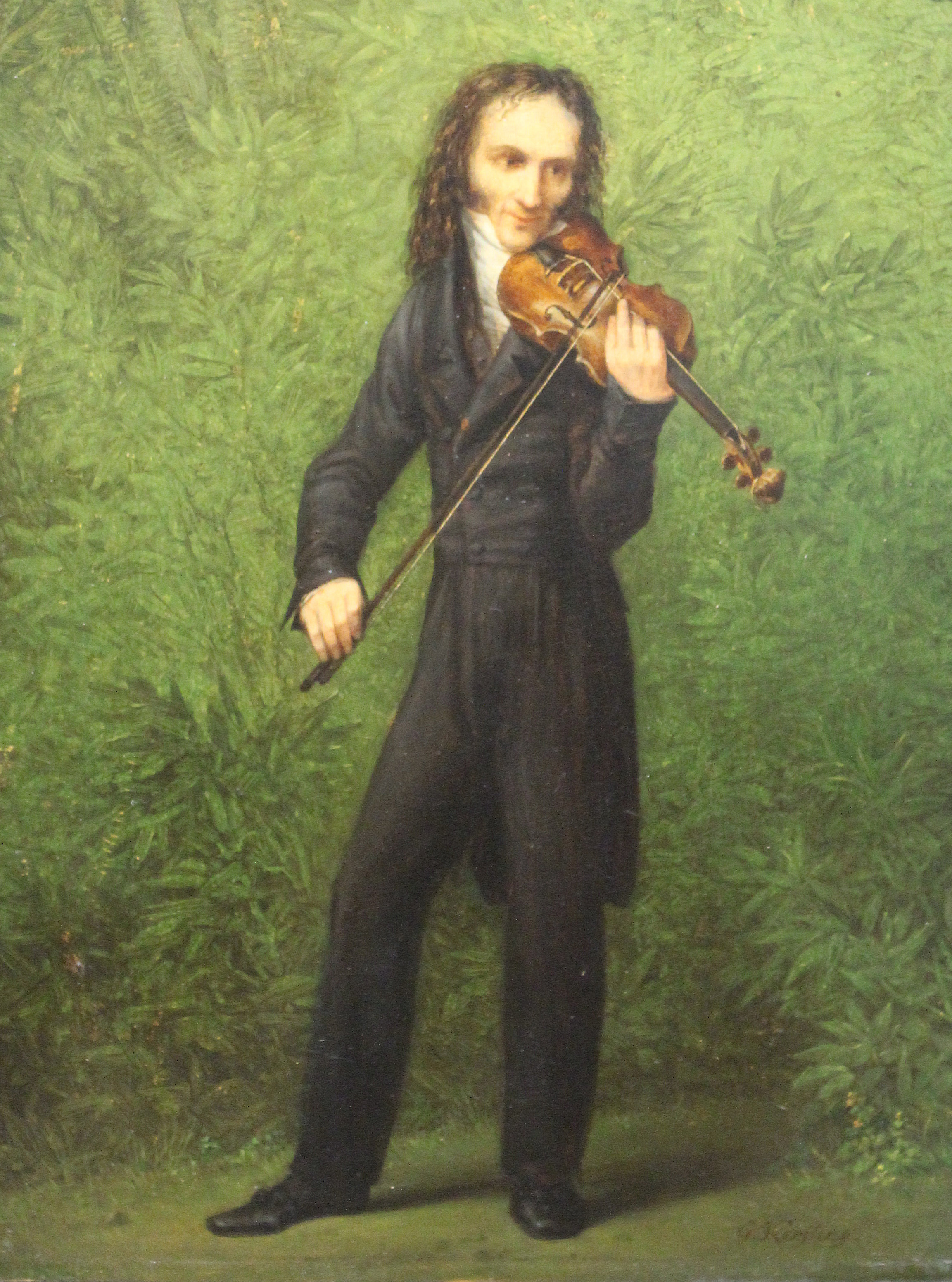
"The violinist Niccolò Paganini", Georg Friedrich Kersting (circa 1829), Galerie Neue Meister, Dresden, Germany
The body as spectacle and mystery
Alongside his musical achievements, Paganini’s physical appearance became a persistent object of commentary. Descriptions from audiences and acquaintances frequently evoke a strikingly thin, pallid figure, with elongated limbs and unusually flexible hands. His gestures while performing, fluid, sometimes contorted, reinforced perceptions of bodily singularity.
In a cultural climate attuned to the dramatic and the extraordinary, such features readily acquired symbolic significance. Paganini’s body became part of the spectacle. His physicality was not neutral but narrativized, interpreted as evidence of otherness. Some observers perceived illness, others eccentricity, still others a corporeal basis for his uncanny talent.
For modern readers, these accounts are deeply evocative. They resemble, at least superficially, descriptions that today might trigger consideration of heritable connective tissue disorders. Long, slender digits and pronounced joint mobility are features well recognized in contemporary clinical practice. Yet such retrospective associations require extreme caution. Historical narratives are prone to exaggeration, selective memory, and myth-making, especially when attached to figures already enveloped in legend.
Illness, frailty, and the Romantic imagination
Paganini’s life was also marked by episodes of illness, further complicating perceptions of his body. Historical records suggest periods of poor health, including conditions common in the nineteenth century such as tuberculosis and complications of infectious diseases. In an era when chronic illness frequently shaped biographies, physical frailty could easily merge with narratives of artistic temperament.
Romantic culture often framed genius and suffering as intertwined. The image of the fragile, tormented artist resonated deeply with contemporary audiences. Paganini’s appearance and reported ailments thus reinforced broader cultural archetypes, potentially amplifying interpretations of his physique in ways detached from objective observation.
Modern medicine enters the narrative
It was only with the development of modern medical genetics that Paganini’s physical features became objects of explicit diagnostic speculation. Twentieth-century physicians revisited historical descriptions, seeking to interpret them within emerging frameworks of hereditary disease. Among the most influential hypotheses was the proposal of Marfan syndrome, articulated in a now-classic JAMA article. The diagnosis possessed intuitive appeal, aligning perceived skeletal features with a recognized genetic condition.
Yet the apparent coherence of such reasoning masks its methodological fragility. Phenotypic variability within Marfan syndrome is considerable, and historical data concerning Paganini are neither systematic nor clinically verified. Subsequent commentators highlighted inconsistencies, questioning whether available descriptions genuinely supported the hypothesis.
Alternative interpretations invoked Ehlers–Danlos syndrome, particularly forms characterized by joint hypermobility. Again, the attraction of the hypothesis lay in its compatibility with anecdotal accounts of exceptional flexibility. But as debates within the medical literature revealed, assigning specific diagnostic categories to historical figures remains inherently speculative.
Two diagnoses, one legend
Among the various medical interpretations proposed over time, two hypotheses have dominated discussion, each seemingly capable of explaining different aspects of Paganini’s extraordinary appearance.
Ehlers–Danlos syndrome (EDS), particularly forms characterized by marked joint hypermobility, offers an intuitively attractive framework. Extreme laxity of ligaments and connective tissue could, at least in theory, account for the remarkable flexibility attributed to Paganini’s fingers and wrists. For a violinist whose compositions demanded unprecedented digital extension and fluidity, such a phenotype appears almost narratively perfect. Hypermobile joints, in this view, become not merely a clinical curiosity but a potential contributor to artistic innovation.
Marfan syndrome, by contrast, has often been invoked to explain Paganini’s reportedly elongated limbs, slender fingers, and strikingly thin habitus. The archetypal marfanoid body — tall, gracile, with arachnodactyly and characteristic facial features — resonates strongly with many historical descriptions. In this interpretive model, Paganini’s appearance is read through the lens of skeletal morphology rather than ligamentous elasticity.
Yet both hypotheses illustrate the inherent ambiguity of retrospective diagnosis. The same descriptive elements (long fingers, unusual flexibility, frail constitution) may be selectively emphasized to support different diagnostic narratives. Historical medicine, like clinical medicine, is susceptible to framing effects.
Complicating matters further is a frequently overlooked historical detail.
Paganini underwent treatments for syphilis that involved prolonged exposure to mercury, a common therapeutic practice of the era. Chronic mercury intoxication is known to produce severe systemic effects, including dental destruction. Paganini ultimately lost his teeth, a consequence that profoundly altered his facial appearance. The resulting hollowed features, sunken mouth, and accentuated gauntness likely contributed to the “cadaveric” or “spectral” descriptions found in contemporary accounts.
This element is particularly instructive. Traits that modern observers might be tempted to interpret as primary phenotypic or genetic characteristics may instead reflect acquired, treatment-related changes. The boundary between disease, therapy, and appearance becomes historically blurred: a reminder that the visible body is never a purely static diagnostic object.
Phenotype and the problem of hindsight
Paganini’s case exemplifies a broader epistemological challenge in medicine: the retrospective interpretation of phenotype in the absence of direct clinical evidence. Modern clinicians are trained to read bodies diagnostically, to translate physical signs into probabilistic judgments about underlying pathology. This cognitive habit, while essential in practice, can become misleading when applied to historical individuals.
Descriptions transmitted through biography, journalism, and artistic representation do not constitute clinical data. They are mediated by cultural expectations, rhetorical conventions, and narrative agendas. The risk is not merely diagnostic error but conceptual distortion: the projection of contemporary disease constructs onto past lives.
Why Paganini still fascinates physicians
The enduring medical interest in Paganini reflects more than curiosity about a celebrated musician. It reveals the powerful attraction of linking exceptional human abilities to identifiable biological substrates. Such narratives resonate with medicine’s explanatory ambitions, offering the promise of reducing mystery to mechanism.
Yet Paganini’s story ultimately resists closure. His legend persists precisely because it occupies the ambiguous space between observable reality and interpretive imagination. For clinicians, this ambiguity is itself instructive. It reminds us that not every striking phenotype maps neatly onto diagnostic categories, and that uncertainty is an intrinsic feature of both historical reconstruction and clinical reasoning.